Empty the list

Are you sure you want to empty the list?
Order lines:
0

Clear the shopping list

You have 0 order rows in your shopping list.
Are you sure you want to clear your shopping list?

Your purchase list

Something went wrong when prices were picked up. Please try again.

Your purchase list is empty

The silent revolution of data centres

How AI and sustainability are changing the infrastructure of the future

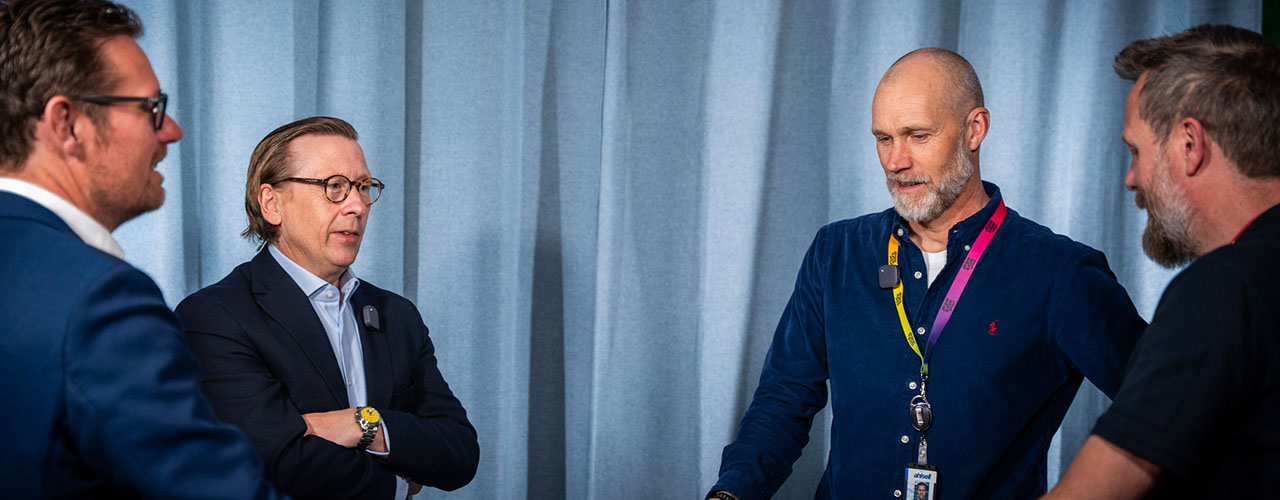
Based on an episode of the Ahlsell Podcast with Fredrik Lindgren (Ahlsell), Magnus Angermund (Hexatronic).


The secret heart of our digital everyday life

Imagine a superhero living in the hidden. Strong, reliable, and secret by nature – but without him the whole community stops. That's data centres in a nutshell, or as Magnus Angermund of Hexatronic aptly describes it: "A secret agent and a superhero combined."


Most of us never think about them. But every time you pay online, stream a series, ask a question to an AI or open your phone, there is a data centre somewhere that enables it. And right now, that industry is in the midst of one of the fastest growth phases in its history.


Three types of data centres – from cloud to basement

For those who want to understand the market, it is good to know the three main segments:


Hyperscalers are the really big players – Google, Amazon, Microsoft and Meta. They are building huge facilities to run their global cloud services. It was precisely the cloud-first trend that once fueled their explosive expansion.


Colocation is a middle ground. Here, an actor builds a data centre and then rents out space – everything from part of a rack to an entire house – to customers who want professional operation without managing it themselves. A bank or an industrial company can place their own servers with a colocation operator and get a guaranteed high availability, without having to become experts in data operations.


Enterprise is when the company or authority operates its data centre entirely in-house. The big banks, the military and government agencies often belong to that category of – data that is too sensitive to entrust to an external operator.


AI changes the game plan – and the cable needs

Previously, a server was like a repository: data was collected and disclosed. But with AI, the servers need to start processing the data – and for that they need to talk to each other. It fundamentally changes the infrastructure.

"Earlier we had a single point in each server. Now the servers must start communicating with each other in a data centre" explains Fredrik Lindgren, who is responsible for telecom and data at Ahlsell.


That dramatically means a lot more fibre cable. And not any fibre – communication is the heart of the plant. A small percentage of the total construction investment, but critical for the entire expensive investment to deliver.


Magnus Angermund also describes how Hexatronic has developed cable systems specially adapted for the connections between data centres – with higher fibre counts and the ability to blow the cable longer distances without having to stop. The result: fewer wells, faster installation, lower cost.


Energy – from diesel power to hydropower

The energy issue is perhaps the one that is changing the most right now. And the numbers are amazing.


About 10 to 15 years ago, a rack in a data centre used maybe 0.5 to 1 kilowatt. Today, 40 to 60 kW per rack is not uncommon, and 100 kW occurs. Magnus paints the picture: "Imagine having a sauna heater at home at 6 to 9 kW. Nowadays you install 100 kW with fans in a closet."


And it doesn't stop there. With next-generation AI hardware, the industry is talking about upwards of 1 megawatt per rack – in the future.


This makes energy supply a crucial issue. And here the Nordic region has a unique opportunity.


Why the Nordic region is hot – when it comes to cold

Sweden, Norway and Finland have several characteristics that make them extremely attractive for data centres:

  • A surplus of renewable electricity – especially hydro power in the north. While the rest of Europe is fighting for electricity capacity, we have in fact in surplus.
  • Cold climate – the cold is not free, but nature helps. And the mindset is important: "It's not about adding cold – it's about taking out the heat."
  • District heating systems – Sweden has a well-developed district heating network, which makes it possible to sell back the heat from the data centres and create revenue.
  • Stable ground and infrastructure – the ground does not move, the power grid is reliable.


Previously, latency – response time – was an obstacle. A bank that wanted to carry out real-time transactions with financial centres in Frankfurt or London could not afford the extra delay that would arise if the server was located in Luleå. But for AI services, where an image may take an extra second to generate, it does not matter as much. The Nordic pros therefore outweigh the cons.


Meta was an early adopter with its facility in Luleå. Today, interest in establishments is growing throughout the Nordic region.


Double up – about safety and uptime

A modern data centre is built to never go offline. And it shows in the design: everything is doubled.


Power supply from two completely different networks, communication from two directions, battery banks, backup power units and chillers – all in two parallel tracks down to each individual server and switch. That makes a plant almost twice as expensive to build, but that's the price of guaranteed uptime.


"99.9 % uptime sounds good – but it is still 8.7 hours a year," Magnus points out. "Today, no one accepts one and a half hours of downtime. It should be five nines as a minimum."


Five nines – 99.999 % – means just under five minutes of downtime per year.


Sustainability: not just a trend, but a business issue

PUE, Power Usage Effectiveness, is the industry's key performance indicator for energy efficiency. It measures how much of the total energy that actually goes to the IT load, versus everything required to run the cold and other infrastructure. A PUE of 2.0 means the support systems draw as much as the IT – a PUE of 1.3 means only 30 % overhead.


Sweden was an early adopter. Already ten years ago, Swedish data centres had PUE levels at around 1.3, driven by business logic: electricity in, data out – the less electricity you use, the more competitive you become.


And that drive is even more important nowadays. When every AI prompt consumes ten times more energy than a regular Google search, and when the EU CSR directive requires reporting of IT footprint, more actors put more consideration into where the data centre should be located.

 

The future: a Nordic hub for global data

"If we are to look into the future, I believe that the Nordic countries can really become a completely new industry for this" says Magnus Angermund.


Fredrik Lindgren at Ahlsell sees 2030 as an intensive construction period and believes that Ahlsell can reduce both construction costs and construction time with its service logistics. The vision: A one stop shop for data centres in the Nordics.


It is not science fiction. It is an industry that is already growing rapidly, powered by AI, cloud and data security – and where the Nordic countries sit on an unusually strong hand of cards.


The next time you ask an AI about something, you now know roughly where the answer comes from.

Message from Ahlsell

Javascript is disabled in your browser. For full functionality, we recommend that you turns on Javascript